

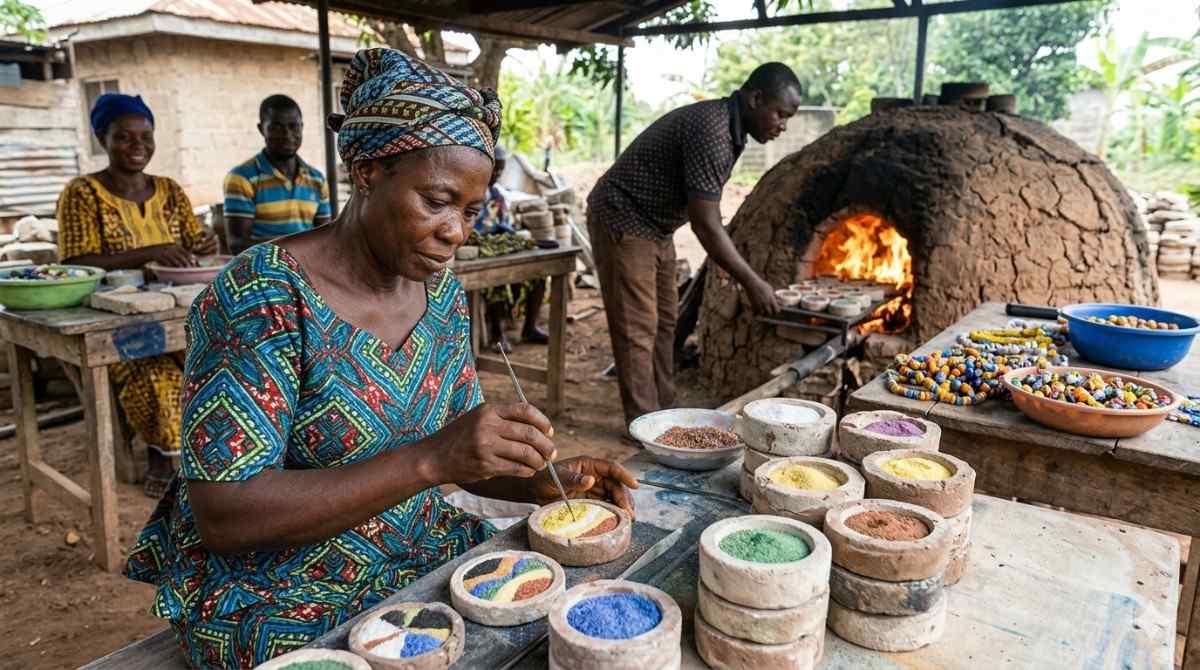
The road to Odumase Krobo winds through the rolling hills of Ghana’s Eastern Region, past roadside stalls draped in kaleidoscopic strands of beads that catch the morning light like stained glass in motion. Before I even reach the workshop of Master Beadmaker Abena Tetteh, I can hear the rhythmic grinding of glass on stone, a sound unchanged for centuries. This is where old bottles become heirlooms, and recycled fragments of the modern world are reborn as sacred objects.
The Krobo people of southeastern Ghana have been crafting beads for well over three hundred years. What began as a practice rooted in spiritual identity, social status, and ceremonial adornment has evolved into a living art form that now carries the weight of cultural preservation. And remarkably, at its heart lies an act of transformation: the turning of discarded glass into something sacred.
For members of the diaspora visiting Ghana, a day in Krobo is one of the most direct and moving encounters with Ghanaian cultural heritage available anywhere in the country. It is not a museum experience. It is a living one.
Gathering the Glass: The Art Begins at the Scrap Heap
Every bead starts not in a furnace, but in a pile of broken bottles. Abena’s apprentice, a sixteen-year-old named Kofi, is sorting through a collection of glass this particular morning, separating brown beer bottles from green mineral water bottles, clear Coca-Cola glass from the deep cobalt of medicine vials. The colour palette of a Krobo bead collection is essentially a map of what Ghana drinks, ships, and discards.
Abena watches Kofi work and offers a quiet correction when he nearly tosses aside a cracked medicine bottle with a particularly vivid teal hue. “That is your finest blue,” she tells him, setting it carefully aside. “You do not find that shade anymore.” It is the first of many lessons I witness today, and it distills the philosophy of Krobo beadmaking into a single moment: nothing is waste until a master says so.
The glass is washed thoroughly, dried in the sun, and then crushed using smooth river stones on flat granite grinding slabs. This process, known locally as “pounding the glass,” requires a specific technique: not too fine, not too coarse. The right consistency is something apprentices spend months, sometimes years, learning to feel.
The Molds: Clay, Memory, and Form
The molds used to shape Krobo beads are themselves objects of artistry. Traditionally carved from a specific locally sourced clay, the molds contain rows of small cylindrical or tubular wells. A thin cassava stalk placed in the centre of each well will burn away cleanly during firing, leaving behind a perfect bead channel.
Abena’s molds are a family legacy. The oldest one she still uses was carved by her grandmother and has shaped thousands of beads over four decades. The clay surface bears a faint shimmer from years of glass residue fused and released from its walls. She keeps it oiled with shea butter between uses, a practice she says prevents cracking and “keeps the mold remembering its purpose.”
For the elaborate patterned beads known as bodom or aggrey, the layering and swirling of coloured powders is a painstaking art in itself, with masters using tiny wooden tools and even their fingernails to coax pigments into desired patterns before firing locks the design in place forever.
Into the Fire: The Kiln and the Transformation
The kilns used in traditional Krobo beadmaking are simple but precise. Constructed from clay and built low to the ground, they are fired with charcoal or wood and must reach temperatures sufficient to melt the glass powder without fully liquefying it. This is perhaps the most critical judgment call in the entire process, and it is made entirely by eye and experience.
Abena fires her kiln twice a day when production is high. She tends the fire with unhurried confidence, adjusting airflow by moving a flat clay tile. “My mother always said the fire is a conversation,” she tells me. “You speak to it with the wood. It tells you the truth with the colour.”
The mold is removed using long wooden tongs and left to cool slowly in open air, never in water. Rapid cooling creates fractures. This patience is non-negotiable. The cooling period can last anywhere from thirty minutes to several hours depending on bead size and ambient temperature.
Surface Decoration: Painting the Story
Once cooled and removed from the molds, many beads undergo surface decoration. Using fine-tipped tools dipped in powdered glass mixed with water, artisans paint geometric patterns, dots, lines, and abstract symbols directly onto the bead surface. The decorated bead then goes back into the kiln briefly, just long enough to fuse the painted glass into the surface.
The symbols used in decoration are not purely aesthetic. Many carry specific meanings within Krobo social and ceremonial contexts. Certain bead patterns are worn only by women who have undergone the dipo initiation rite, a coming-of-age ceremony central to Krobo culture. Others are associated with wealth, fertility, or protection. A knowledgeable observer can read a woman’s bead collection much like a text, understanding her status, history, and identity from the colours and markings she wears.
Abena pauses to show me a strand of particularly ancient-looking beads she keeps stored separately. “These were my great-grandmother’s,” she says quietly. “She wore them at her dipo. I will wear them when my daughter has hers.” The beads, over a century old, glow with an undimmed warmth. The glass that made them has long since been forgotten as glass.
Passing It Down: The Apprentice System
The transmission of Krobo beadmaking knowledge is almost entirely oral and observational. There are no manuals, no formal schools, and no certificates. Knowledge lives in the hands and eyes of its practitioners, passed from grandmother to daughter to granddaughter in kitchens, compounds, and workshops.
Kofi has been learning from Abena for two years. He began by fetching, washing, and sorting glass. After six months, he was allowed to grind. Only in the past few weeks has he been permitted to fill his first molds independently, and each attempt is examined with the same critical eye Abena would turn on her own work. “When he stops looking at me for approval before he places the stem,” she says, “then he is becoming a beadmaker.”
Practitioners believe that a bead carries the energy of the person who made it, and that rushed or careless making produces spiritually hollow work, regardless of how it looks to the eye. Speed is not the point. Understanding the relationship between material, fire, and form is.
Krobo as a Destination: Why Diasporans Are Making the Journey
For members of the African diaspora visiting Ghana, the Eastern Region and the Krobo hills offer something that few other destinations in West Africa can match direct, unhurried access to a craft tradition that has survived colonialism, industrialisation, and globalisation with its soul intact. A visit to a working beadmaking compound is not a heritage museum experience with a gift shop at the end. It is an invitation into a living household practice, where the tools, techniques, and materials are the same as they were generations ago.
Many diasporans who have made this visit describe it as a turning point in how they understand their relationship to Ghanaian culture. Watching a bead move from a broken bottle to a fired object of beauty in the space of an afternoon makes the abstraction of “African heritage” suddenly tactile and specific. You are not being told about the culture. You are sitting inside it.
The Krobo bead markets at Odumase Krobo and Somanya are best experienced on market days, Tuesdays and Fridays, when artisans gather from across the region to trade. The sheer variety on display, from contemporary designs made for international fashion buyers to antique aggrey beads traded for centuries along West African trading routes, gives a visitor the full arc of the tradition in a single morning walk.
For those coming from the UK, North America, or the Caribbean as part of a broader roots journey, Krobo pairs naturally with visits to Cape Coast Castle, the Assin Manso Slave River Site, and the Ashanti Cultural Centre in Kumasi. Together these sites form a powerful arc through Ghanaian history that no diaspora visitor should leave the country without experiencing.
Planning Your Visit: Tours with Diaspora Affairs Ghana
Diaspora Affairs Ghana offers structured Ancestral Heritage Tours designed specifically for diasporans who want more than a tourist itinerary. These tours are built around the understanding that for many visitors, a trip to Ghana is also a journey of identity, and that the best guide is not just someone who knows the roads but someone who understands what it means to return.
Popular tour destinations available through DAGh include:
Assin Manso Slave River Site, where enslaved Africans were bathed in the river before being marched to the coast. For many diasporans of West African heritage, this site carries a particular weight.
Kakum National Park, Ghana’s famous canopy walkway suspended above the Central Region rainforest, which offers a striking contrast to the historical weight of the coastal castle visits nearby.
Kwame Nkrumah Mausoleum in Accra, the resting place of Ghana’s founding president and a defining figure of pan-African thought.
Ashanti Cultural Centre in Kumasi, a living repository of Ashanti craft, including kente weaving and goldsmithing, complements a Krobo beadmaking visit with the broader picture of Ghanaian artisanal heritage.
Volta Lake Tour, a scenic and reflective journey across one of the largest man-made lakes in the world, passing through rural Ghanaian riverine communities.
Tours are available as individual heritage expeditions or collective diaspora group tours. Every DAGh Heritage Tour includes automatic enrolment into the Basic Membership tier, which gives participants access to the organisation’s legal and resource network. For diasporans who discover during their visit that they want to stay longer, or eventually return permanently, this membership provides a direct bridge to DAGh’s relocation and immigration support services.
To plan a tour, visit the DAGh Ancestral Heritage Tours page or contact the team directly to discuss a customised itinerary. Those arriving on a Visa on Arrival can also access DAGh’s pre-approval support service to ensure a smooth and legally compliant arrival before the journey begins.
Threats to the Tradition and the Road Forward
The Krobo bead tradition is alive, but it is not without pressure. The market for cheap imported plastic and acrylic beads has undercut traditional artisans economically. Many younger Krobo people leave for Accra or abroad, breaking the chain of transmission. Some techniques for creating specific historic patterns are already known only to a handful of practitioners.
Yet there is also a counter movement gathering strength. Global interest in authentic West African craft objects has opened international markets for master beadmakers. Diaspora tourism has become a meaningful source of income and attention for Krobo artisans. When a returning diasporan buys directly from the compound rather than from a city souvenir shop, that transaction carries both financial and cultural weight. It signals to the community that this knowledge is worth preserving.
There is also a quiet resonance in the sustainability story. Krobo beads were a circular economy practice long before that phrase existed. Every bead is recycled material, reimagined. In an era of growing environmental consciousness, that is not merely tradition. It is wisdom.
The Bead That Was a Bottle
By late afternoon, Abena opens the cooled mold from her midday firing and tips the finished beads into her palm. They catch the golden Ghanaian light and scatter it in small, warm constellations across her hands. A few hours ago, these were chips of broken brown glass on a grinding stone. Now they are objects of quiet beauty, ready to be polished, decorated, and strung.
She holds one up between thumb and forefinger, turning it slowly. “People ask me what makes a bead Krobo,” she says. “I tell them: the glass is from anywhere. The fire is from our land. The knowledge is from our grandmothers. You put those three things together and you get something that belongs nowhere else in the world.”
She sets the bead down on the workbench beside the ancient family mold, and the two objects sit together, three generations apart and entirely at home with each other. For any diasporan who has ever felt the pull of something they cannot quite name, this workshop is one of the places that pull is trying to take them.