

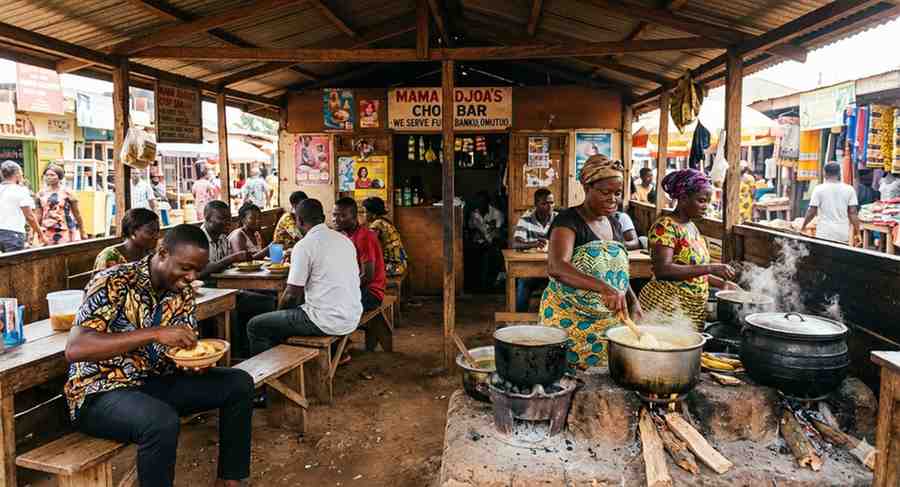
If you are planning a tour of Ghana, you are probably thinking about Kakum National Park, the Cape Coast Castle, the Larabanga Mosque, or the kente weavers of Bonwire. All of these are essential. But there is one stop that does not appear on most itineraries and should be on every single one: the chop bar.
A chop bar is not a bar in the Western sense. The word “chop,” borrowed from West African Pidgin, simply means food. These are neighbourhood canteens, roadside kitchens, and open-air dining rooms where office workers, market traders, students, and builders all eat shoulder to shoulder. Prices range from GHS 20 to GHS 60 for a full meal. Your first visit will feel slightly chaotic. Your second visit will feel like coming home.
Why Chop Bars Belong on Every Ghana Tour Itinerary
A tour through Ghana is also a tour through its food geography. The closer you get to the coast, the more banku and tilapia dominate the tables. Head north toward Tamale and Bolgatanga and the landscape shifts entirely to Tuo Zaafi, millet-based stews, and flavours borrowed from the Sahel. A morning at a chop bar in Accra and an afternoon at one in Kumasi will tell you more about regional identity than most museums can.
If your tour operator has not included at least one chop bar stop, ask them to. If you are travelling independently, use the guide below as your entry point.
Before You Go: What Travellers Need to Know
Ghana’s chop bars are concentrated along market streets, near bus stations, and tucked into residential neighbourhoods. They do not advertise. Some have handwritten signs; most are identified simply by the crowd gathered outside and the smell of palm oil and wood smoke drifting into the street from half a block away.
Accra, Kumasi, Cape Coast, Tamale, and Takoradi all have thriving chop bar cultures, but each city has its own regional emphases.
Opening hours follow hunger, not clocks. Most chop bars open between 6am and 8am and close when the pots are empty, typically by 2pm or 3pm. The best stalls can sell out of their signature dish by midday. Arrive early or accept what remains, which is usually still excellent.
The ordering system is simple once you understand the logic: you choose your swallow first, then your soup, then your protein. Everything else is negotiation.
The Swallows: Your Starchy Foundation
A swallow is the cornerstone of the chop bar meal. These are dense, smooth, dough-like carbohydrates eaten with the right hand, pinched into small pieces and dipped into whichever soup or stew you have chosen. You do not chew most swallows. You roll a small portion between your fingers, dip, coat in soup, and swallow whole. The technique takes one or two attempts to feel natural. By your third visit, your hands will know exactly what to do.
Fufu
Akan staple · Best experienced in the Ashanti Region
The most iconic swallow in Ghana, fufu is made from boiled cassava and plantains (or yams) pounded together in a large wooden mortar until perfectly smooth and elastic. The result is a pale, slightly chewy mound, always served submerged in soup. In Akan culture it is hospitality made edible, the dish a host prepares when someone important arrives. If your tour takes you through Kumasi or the Ashanti heartland, fufu with groundnut soup is not optional.
Banku
Ga and Ewe tradition · Accra and the Volta Region
Fermented corn and cassava dough cooked into a soft, slightly sour ball with a smooth, silky texture. The fermentation gives banku a gentle tanginess that cuts beautifully through rich, spiced stews. It is Accra’s most common chop bar staple, almost always paired with okra stew and grilled tilapia. For first-time visitors arriving through Kotoka, banku and tilapia is the meal to seek out on day one.
Omotuo (Rice Balls)
Sunday tradition · Nationwide
Soft, well-cooked rice mashed and formed into smooth spherical balls. Omotuo is a Sunday ritual across much of Ghana, traditionally served with groundnut soup or palm nut soup after church. It is gentler in texture than fufu or banku and makes an ideal introduction for travellers who want something familiar underfoot while still eating authentically.
Konkonte
Nicknamed “face the wall” · A history lesson in a bowl
A dark brownish-grey swallow made from dried and powdered cassava, konkonte has an earthy, slightly bitter character unlike any other swallow. The nickname “face the wall” is a wry reference to its reputation as food eaten in lean times. Today it is eaten with pride and pairs beautifully with groundnut or kontomire soup. Understanding konkonte is understanding resilience in Ghanaian food history.
Tuo Zaafi (TZ)
Northern Ghana · The essential meal of a Tamale tour
A soft, corn-based swallow from the north, Tuo Zaafi is the default carbohydrate in Tamale’s chop bars and one of the most distinctive regional eating experiences in the country. It is almost always served with Ayoyo soup, a viscous, slightly sticky broth made from jute leaves with an earthy, green depth unlike anything in southern Ghanaian cooking. If your tour includes the north, this is the meal to plan a stop around.
The Soups: Where the Flavour Lives
At a chop bar, the soup is not a side dish. It is the engine of the meal. Choose well, and every pinch of fufu or banku you pull from that bowl will taste like it was made specifically for you.
Light Soup (Nkrakra)
Tomato-based · Pairs with fufu or rice balls
A spiced, tomato-forward broth fragrant with onion, scotch bonnet pepper, and a combination of goat meat, fish, or both. Light soup is called light not because it lacks depth, but because it does not rely on a thick base ingredient. The heat level is genuine. Do not be fooled by the colour.
Groundnut Soup
Rich and nutty · Pairs with fufu or omotuo
Made from roasted peanuts ground into a thick paste and cooked down with tomatoes, onions, and pepper, groundnut soup is one of the most deeply satisfying things in the Ghanaian kitchen. Brick-red, slightly sweet, and warm with spice, it coats the fufu in a way that makes you wonder why you ever ate anything else. Order it with goat meat if it is available.
Palm Nut Soup (Abenkwan)
The richest option · Pairs with fufu
Extracted from the pulp of palm fruit, palm nut soup is thick, orange-red, and intensely flavoured in a way that is difficult to describe to anyone who has not tasted it. It is the most distinctly West African of all the soups, with a deep, oily richness that feels almost ceremonial. In Akan households, abenkwan is the soup you make for special occasions.
Okro Soup (Okra Stew)
Viscous and seafood-forward · Pairs with banku
A thick, green, viscous stew made from blended and cooked okra, filled with a combination of seafood, meat, and vegetables. The texture is deliberately slick and sticky. Okro soup and banku is Accra’s foundational food pairing, and no coastal tour is complete without it.
Kontomire Soup (Palava Sauce)
Green stew · Pairs with any swallow or rice
Made from cocoyam leaves cooked with melon seeds (egusi), smoked fish, and onion, palava sauce is a deeply flavoured green stew with a texture somewhere between a thick soup and a leafy vegetable dish. One of the older preparations in Ghanaian cooking, with a satisfying bitterness that balances beautifully against fufu.
The Proteins: Building Your Bowl
Goat Meat is the most prized protein at the majority of Ghanaian chop bars. Slow-cooked until tender, deeply spiced, and carried in every serious soup on the menu.
Tilapia is the fish of the coast, either grilled whole over charcoal or fried crisp in palm oil. A grilled tilapia with banku and okro soup is the meal that defines Accra.
Wele (Cow Skin) is boiled and spiced cow skin with a dense, chewy texture that absorbs the flavour of whatever soup it sits in. Do not dismiss it on principle.
Bushmeat including grasscutter (cane rat) and antelope is slow-cooked and added to soups or served alongside. Grasscutter has a rich, slightly gamey flavour and is considered a delicacy at stalls that carry it.
African Snails are large land snails, cleaned, spiced, and cooked until tender. Common in southern chop bars, especially those near the forest belt.
Beyond the Swallow: Dishes Worth Knowing
Red-Red
National staple · A great first chop bar dish for visitors
Black-eyed peas stewed in palm oil with tomatoes, onions, and scotch bonnet pepper, served with fried ripe plantain on the side. Red-red is approachable, filling, genuinely delicious, and cheap enough that ordering seconds requires no deliberation at all. A natural first choice for travellers who want to ease in gently.
Waakye
Morning ritual · The breakfast of choice at any city market
Rice and beans cooked together with dried sorghum leaves, which turn everything a deep, striking purple-brown. Waakye is Ghana’s quintessential breakfast and midday meal. The accompaniments are the point: fried fish, boiled egg, gari, shito, spaghetti, and whatever else the stall owner has assembled. No two waakye sellers build the same plate. If your tour begins with a morning market visit, look for the waakye queue.
The Condiments: Do Not Underestimate Shito
Every chop bar worth visiting has a jar of shito on the table or behind the counter. Shito is a dark, intensely flavoured pepper sauce made from dried fish, dried shrimp, scotch bonnet peppers, onion, and palm or vegetable oil, cooked down slowly until it becomes a thick, almost black paste. It is simultaneously a condiment, a seasoning, and a heat delivery system.
Start with a small amount. Once you understand shito, you will find yourself wanting it on everything. Bottles are sold at markets across Accra and make excellent souvenirs to bring home.
Tour-by-Tour Chop Bar Guide: What to Eat and Where
The beauty of planning chop bar stops around your tour route is that every region has its own must-eat moment. Here is how to match your itinerary to the food.
Accra City Tour
Start at Auntie Muni’s in Nima for waakye before 10am. The shito here is darker and smokier than most. GHS 20 to 35. For lunch, head to the Makola Market Stalls in central Accra for banku and tilapia eaten standing up beside traders and shoppers. GHS 25 to 50. On Sunday afternoons, the Labadi Road roadside stalls near the beach serve some of the best red-red in the city. GHS 15 to 30.
Kumasi and the Ashanti Region
Kejetia Market in Kumasi contains the most intense fufu experience in Ghana. The groundnut soup here has been refined over generations. Come hungry and come early. GHS 25 to 45. A visit to Kejetia pairs naturally with a tour of the market itself, one of the largest in West Africa, and Manhyia Palace nearby.
Cape Coast and the Central Region
The coast means banku and tilapia, eaten as close to the water as possible. Look for informal chop bars along the road between Cape Coast and Elmina. The palm nut soup in this region is particularly rich, made from palm fruit grown close to the forest belt. Pair a chop bar lunch with an afternoon at Kakum National Park.
Tamale and the Northern Region
Tuo Zaafi with Ayoyo soup is non-negotiable. Tamale’s market area has dozens of stalls serving TZ from early morning. This pairs well with a visit to the Larabanga Mosque, the oldest mosque in Ghana, and the Mole National Park safari experience. Eating TZ in Tamale and watching elephants at Mole on the same day is one of the better days you can have in West Africa.
Practical Tips for Tour Groups
- Arrive before 1pm. The best soups sell out by early afternoon and will not be replenished until the next day.
- Ask what the soup is before you sit down. The most popular item will be available; the most interesting one might have only a few portions left.
- Eat with your right hand for fufu, banku, and all swallows. A bowl of water for washing hands will be provided before and after the meal.
- Water comes in small, sealed plastic sachets called pure water, costing about GHS 0.50 each. Buy two. The food is spicy.
- If you see a long queue at a specific stall, join it. The queue is the review system.
- A full meal of swallow, soup, and protein should cost between GHS 25 and GHS 60. If you are paying significantly more, you are likely in a tourist-facing restaurant rather than a genuine chop bar.
- The cook is usually also the owner. A direct compliment about the food is the highest currency in any chop bar.
A Note on Etiquette and Enjoyment
Ghanaian food is communal by instinct. If you are eating with others, sharing from the same bowl is normal and encouraged. Complimenting the cook directly, in Twi or Ga if you can manage it, will earn you a reaction that makes the entire trip worthwhile.
“Eɔyɛ de” (ay-yeh-deh) means “it is delicious” in Twi. It is perhaps the most useful phrase a food tourist can learn. Use it freely. It is almost always true.