
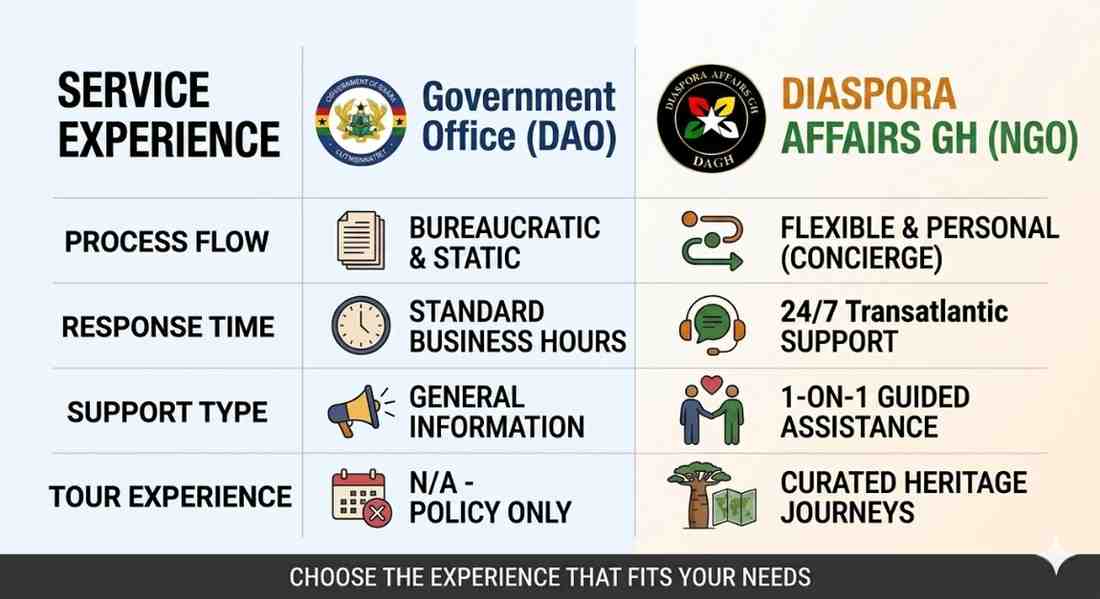
Returning to Ghana involves engaging two distinct systems: the government’s official channels for documentation, residency, and citizenship, and NGO partners like Diaspora Affairs GH that translate complex regulatory requirements into practical, step-by-step guidance. Government processes such as the Ghana Card, residence permits, and citizenship applications carry legal authority but are often difficult to navigate independently due to opaque procedures and shifting timelines. DAGh bridges this gap by acting as an in-country operational partner, providing legal oversight, risk mitigation, and continuity of support that government channels alone do not offer to returning diaspora members.
Planning your journey home to Ghana often starts with a search for official documents, but it ends with a search for community. While the Government of Ghana provides the legal framework for entry, our NGO provides the heartbeat of the experience. Understanding the difference between Policy and People is the secret to a stress-free homecoming.
Section 1: The Government’s Role
The Official Framework for Returning Home
When it comes to your legal right of return, the Government of Ghana is the authority. Specifically, the Ghana Immigration Service (GIS) and the Diaspora Affairs Office at the Presidency manage everything at the policy level. They are the institutions responsible for issuing the documents that get you through the door.
Here is what they handle:
- Issuing visas and processing Visa on Arrival applications
- Managing Dual Citizenship applications and approvals
- Setting and updating national immigration policy
It is important to understand one thing clearly: these are high-volume, process-driven offices. They are built to handle thousands of applications efficiently, not to hold your hand through the experience. One-on-one ancestral guidance, airport concierge services, and personalised relocation support are simply not part of what they offer. That is not a criticism. It is just the reality of how government institutions operate at scale.
Keywords relevant to this section: Ghana Immigration Service, Visa on Arrival requirements, Ghana Dual Citizenship.
Section 2: Our NGO’s Role
The Concierge Layer That Government Cannot Provide
Think of our NGO as the bridge between official policy and real lived experience. We do not replace the government. We make the government’s processes easier to navigate, and we provide the layer of human support that no official desk can offer.
Here is what we do:
- Visa Assistance: We review your host invitation letters and documentation before you submit them, so your visa application does not get rejected on a technicality.
- Ancestral Heritage Tours: We go beyond the Year of Return slogans to offer deeply personal, DNA-linked heritage experiences that government tourism offices do not curate.
- Relocation Soft Landing: From finding trusted real estate to walking you through the Ghana Card process, we provide the practical, ground-level guidance that helps you actually land and settle.
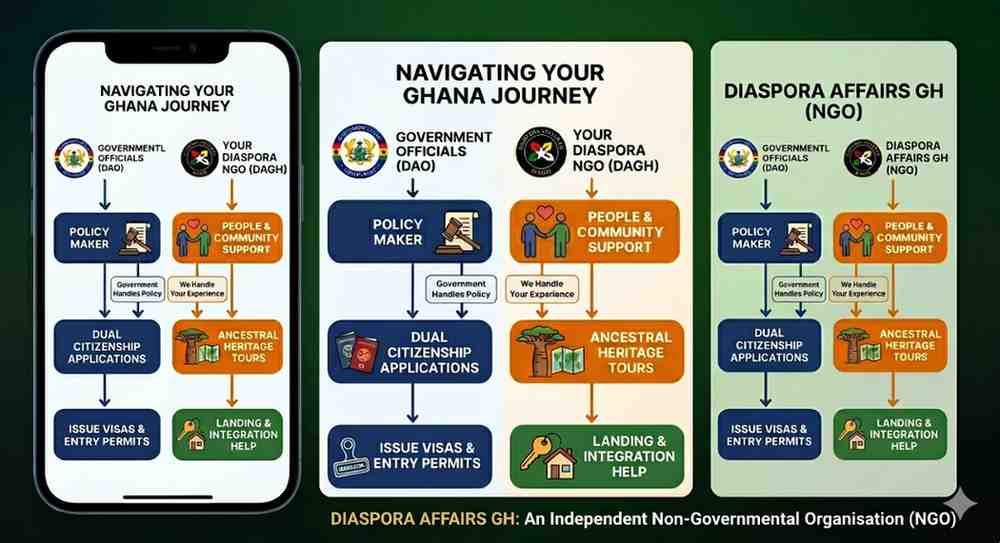
The government gives you the stamp. We give you the support system.
Government vs. NGO: A Quick Comparison
| Government of Ghana | Our NGO |
| Issues visas and dual citizenship | Reviews and prepares your application documents |
| Sets national immigration policy | Provides updates and advocacy when policies shift |
| Manages entry at a national scale | Offers personal, one-on-one guidance |
| No ancestral or cultural programming | DNA-linked heritage tours and cultural experiences |
| No relocation support services | Trusted real estate referrals and Ghana Card guidance |
| High-volume, process-driven | Human-first, community-centred |
Section 3: The 2026 Reality
What Has Changed and Why It Matters for the Diaspora
2026 is not 2019. The landscape for diaspora returns has shifted considerably. Following the UN resolution on reparatory justice in March 2025, there has been a renewed global conversation about the rights and pathways available to members of the African diaspora seeking to reconnect with the continent.
At the same time, some citizenship pathways have been paused or recalibrated as the government reviews its processing frameworks. This is not unusual, but it does create uncertainty for people in the middle of their planning.
This is exactly where our NGO’s value becomes most visible. When government policies shift or pause, our organisation stays active. We monitor changes in real time, communicate updates directly to our community, and continue advocating for diaspora rights even when official channels go quiet.
If you are relying solely on government websites for information, you may find yourself waiting for updates that are slow to arrive. Our community keeps you informed and supported through every policy shift.
Ready to Come Home?
Do not navigate the “Gateway to Africa” alone. Use the government for your stamps, but use our NGO for your soul.
View our 2026 Heritage Tour Calendar
View our NGO-Verified Visa on Arrival Guide