

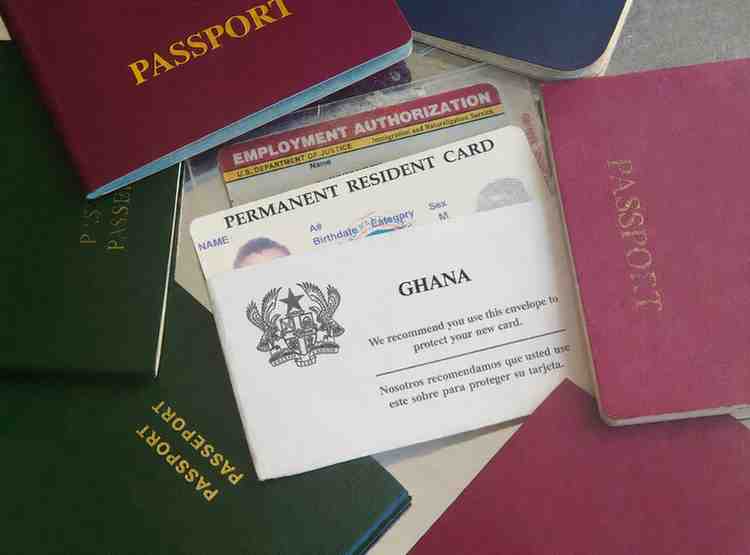
To legally live and work in Ghana as a foreigner or diaspora member, you need two separate authorizations from the Ghana Immigration Service (GIS): a work permit and a residence permit. This requirement applies to all foreign nationals, including ECOWAS citizens. Permits are typically issued for one year in the first instance and are renewable annually, and the two-phase process below outlines what each stage involves.
Phase 1: Obtaining a Ghana Work Permit
A work permit authorizes you to be employed in Ghana. It is tied to a specific employer or an established business, and it must be secured before a residence permit tied to employment can be issued. Applications are typically submitted by your employer or business entity to GIS.
Core document checklist
- Application letter drafted on the company’s official letterhead
- Business registration documents, including the Certificate of Incorporation, company Constitution, and Form 3
- Tax Clearance Certificate showing the company’s current local tax compliance
- Valid employment contract or official appointment letter
- Your updated CV alongside relevant educational or professional certificates
- Regulatory approvals where applicable, such as a GIPC Certificate, Ghana Free Zones Authority (GFZA) license, or sector-specific letters from bodies like the Minerals Commission
- Original police clearance certificate from your home country or country of recent residence
- Bio-data page of your valid passport, and a copy of the employer’s authorised signatory passport
Individuals can also apply directly by attaching the required documents from their employer, or the employer can submit the application on the employee’s behalf. A police clearance certificate is required for the work permit stage, but it is not required again for the residence permit stage.
Phase 2: Obtaining a Ghana Residence Permit
Once your work permit is approved, or once you qualify under another category such as study, self-employment, retirement, religious activity, or dependency on a principal applicant, you must apply for a residence permit to legally live in Ghana for longer than 90 days. A residence permit is not the same as a visa. It allows the holder to travel in and out of Ghana as many times as needed within its validity, without needing a separate visa each time.
Before you apply
- Non-Citizen ID Card. All foreign nationals staying in Ghana beyond 90 days must register for this card. It costs around USD 120 for first issuance and USD 60 for renewal.
- GIS medical examination. A medical check at the GIS clinic is mandatory for all categories, including renewals. Medical reports from your home country or another facility are not accepted. The exam typically costs between GH₵1,200 and GH₵1,500, or around USD 250 for first-time screening and USD 150 for renewal.
Core document checklist
- Completed Residence Permit application form (Form E) issued by GIS
- Application letter addressed to the Comptroller-General of Immigration, stating your personal details, reason for the permit, and the period sought
- Valid passport with sufficient validity to cover the permit duration
- Copy of the Work Permit approval letter, where applicable
- Non-Citizen ID Card
- GIS medical examination report
- Recent passport-sized photographs
- Employment contract or assignment letter signed by the employer, for work-based applications
Documents issued outside Ghana generally need to be authenticated and, where relevant, translated into English by a certified translator. GIS may request supplementary documents or invite you for clarification while your application is under review.
Fees
Residence permit fees vary by nationality and permit category. Government fees for permits valid for one year are broadly grouped as follows, though you should always confirm the current schedule on the GIS fees and charges page before paying:
- Work and Residence Permit, ECOWAS nationals: around USD 500
- Work and residence permit for other foreign nationals: around USD 1,000
- Residence Permit under GIPC Automatic Quota, NGO, or missionary status for all nationalities, including ECOWAS: around USD 300
- Dependant residence permit: around GH₵388
Application process and timeline
- Complete the GIS medical examination and register for your Non-Citizen ID Card, since both are normally required before your residence permit application can proceed.
- Prepare your Residence Permit application documents and submit them to the Ghana Immigration Service.
- Pay the applicable government fee at the time of submission.
- Allow the standard processing window, generally around 2 to 4 weeks, though it can extend up to 8 to 10 weeks depending on the permit category and how complete your file is. GIS typically retains your passport for the duration of the review, so plan any travel accordingly.
- Once approved, GIS endorses your passport with the residence permit.
Other Residence Categories to Know
- Indefinite residence status. Available to foreign nationals who wish to reside in Ghana permanently. It requires a sponsor, attestation letters from two Ghanaians who are notaries public, lawyers, or senior public officers, evidence of property or company ties where applicable, and a current police report from Ghana.
- Right of Abode. A residence status generally aimed at persons of African descent who meet specific criteria set by GIS, distinct from the standard work-based residence permit.
- Dependent permits. Issued to dependants of expatriates and Ghanaian nationals holding foreign passports, including spouses and children.
Key Things to Know
- Permits must match your purpose. A residence permit is always tied to a specific purpose, such as employment, study, self-employment, or retirement, and does not authorize work unless work is specifically included.
- Overstaying has penalties. Overstaying on a tourist or business visa can attract a penalty of around GH₵300 per month. Letting a work permit lapse without renewal can attract a penalty of around USD 100 per month.
- Employers carry responsibility. Work permits must be sponsored by a registered Ghanaian company or NGO, and the employer is legally responsible for the foreign employee’s compliance.
- One employer at a time. You cannot work for two employers on a single work permit. If you change jobs, your previous employer must cancel your existing permit before you apply for a new one with your new employer.
- Renewals follow the same route. Work and residence permits can generally be renewed using a process similar to the original application, though fees may vary slightly.
Click here to apply for a resident permit with Diaspora Affairs Ghana today!